ARISE2 has received funding from the European Union’s Horizon Europe’s research and innovation programme under the Marie Skłodowska-Curie grant agreement No. 101178241.

Career Accelerator for Research Infrastructure Scientists
ARISE2 targets technology and method development experts with STEM backgrounds who are interested in using their expertise to advance research in the life sciences.
To address urgent challenges to human and planetary health new technologies and services are needed in the Life Sciences. ARISE2 is designed to meet this need by training fellows in the development of technologies and methods for improvement of scientific services, while also preparing them for careers in research infrastructures (RI) to make these advances available to the scientific community accelerating progress.
ARISE2 is an MSCA-funded postdoctoral fellowship programme offering talented STEM (science, technology, engineering and mathematics) fellows from around the world the unique opportunity to work on the development and/or improvement of technologies for Life Science Research while developing the expertise needed for a career in research infrastructures making them sought after experts both in academia and industry.

With 29 member states, laboratories at six sites across Europe and thousands of scientists and engineers working together, the European Molecular Biology Laboratory (EMBL) is a powerhouse of biological expertise. EMBL is an intergovernmental organisation with the mission of promoting molecular biology research in Europe, training young scientists, and developing new technologies.
Please watch the recording from the information webinar to learn more about the ARISE2 programme and how to apply:
ARISE2 has received funding from the European Union’s Horizon Europe’s research and innovation programme under the Marie Skłodowska-Curie grant agreement No. 101178241.
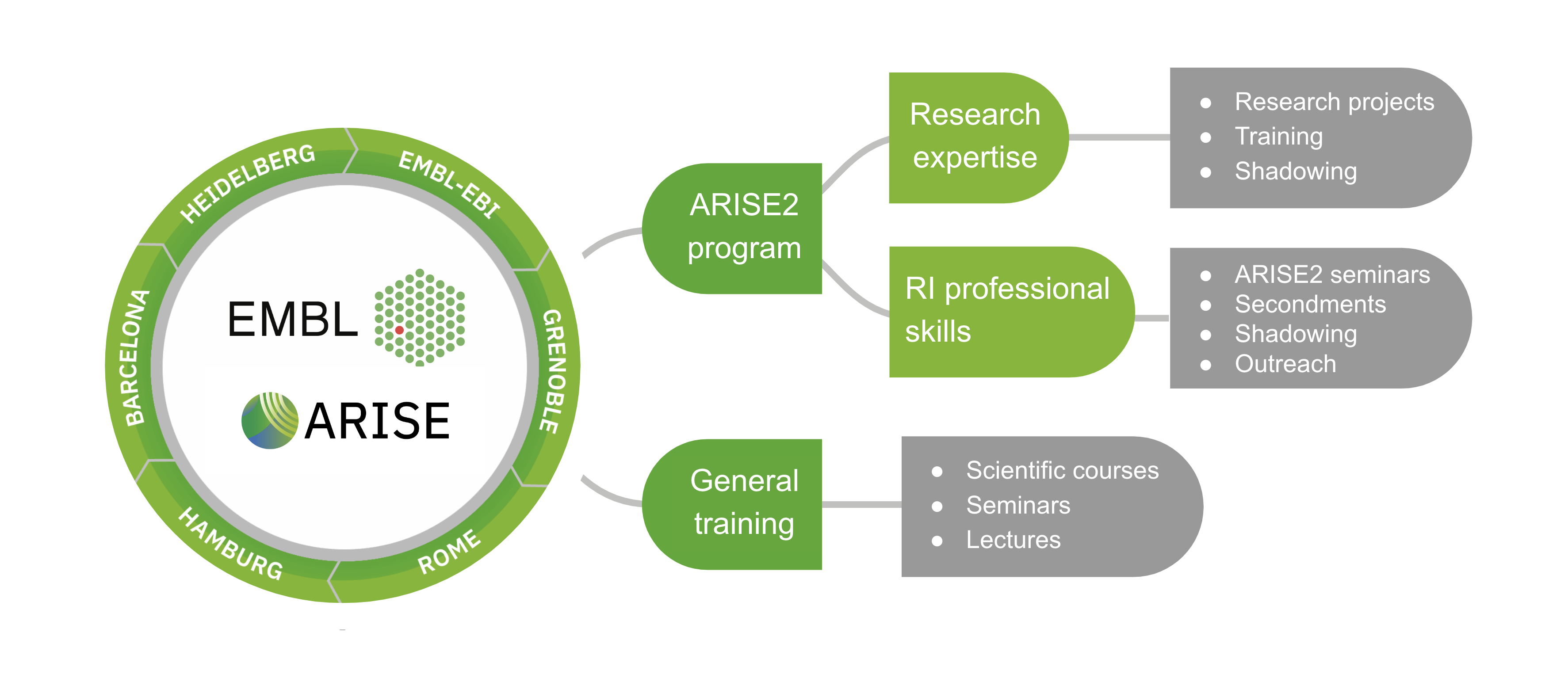
ARISE2 is a unique fellowship programme designed to train the next generation of Research Infrastructure (RI) experts through cutting-edge technology development, interdisciplinary collaboration, professional skills training and career support.
ARISE2 fellows receive 3-year contracts to work on the development of new technologies for the life sciences or the improvement of existing technologies. This is coupled to a comprehensive training programme that encompasses both programme-specific and individually tailored training opportunities and career development support. Training is divided into three core areas:
1. Research training including practical experience in service provision and job shadowing;
2. RI professional competencies;
3. Career development support and individualised training.
Fellows work on self designed research projects to develop technologies for use in life science research. They optimise their technologies by applying it to the researcher projects of others gaining insight into different areas of life sciences, service provision and user needs. They prepare and maintain a data management plan for their projects according to EMBL’s Open Science Policy with the goal of managing their data according to FAIR and Open standards.
Fellows have a main supervisor from EMBL, who is a group or team leader. Fellows also have an external co-supervisor for scientific consultations, either from the long secondment host organisation or a collaborating partner who participates in the 3 year research project. Finally, fellows have an academic mentor for career development consultations. It is also possible for fellows who are in research groups to have an advisor who has experience with service provision.
In line with ARISE2’s focus on hands-on training, fellows have the option to participate in the provision and maintenance of advanced services. This experience equips them with a deeper understanding of how RIs operate and the processes involved in service delivery. To allow fellows to focus on their own research project, this activity is not mandatory and limited to 10 days/year. Fellows hosted in groups that do not provide a service have a service-providing advisor to enable such an experience.
Fellows also complete secondments and short visits to enhance their interdisciplinary and intersectoral experience and support their scientific training and career development. These include two external secondments and two internal visits, enabling knowledge transfer across different sectors and expanding fellows’ professional networks.
| Research-supporting secondments |
|---|
| Long secondment (between 2-6 months) at a partner organisation. The partner collaborates on a part of the research project providing access to novel methods, instrumentation, and expertise. If the partner is collaborating on the full 3-year research project, fellows may spend up to 11 months on secondment. |
| Shadowing of a user at EMBL (5 days in the first 6 months of the fellowship): Fellows gain insight into how users prepare for service access, where and when they need support, their expectations, and how they handle data. |
| Career-supporting secondments |
|---|
| Short visit/job shadowing (1-2 weeks at any time in the fellowship) at a partner or non-partner organization: Fellows gain insight into the operational set ups at other organizations, develop professional skills, and build their networks. |
| Interdisciplinary visit to another EMBL facility (1 week at any time during the fellowship): Fellows learn about provision of service or technology development in complementary disciplines |
RI professionals’ competencies are developed through a structured curriculum of mandatory ARISE2 seminars and a one-week school. This is reinforced during secondments, visits, pilot service provision of fellow’s technology and practical exercises in service provision (see 1) providing fellows with the skills needed to transition into senior roles within RIs.
The curriculum covers:
The one-week ARISE2 school in the 2nd year of the fellowship focuses on strategic topics such as RI operations, team management, budgeting, defining and promoting services, collaborating with industry, and leveraging novel developments in RIs.
ARISE2 encourages fellows to engage with the broader community through outreach and communication activities. Fellows participate in training provided by EMBL’s Science Education and Public Engagement office (SEPE) and Communications team, learning how to effectively promote the importance of life sciences and RI careers. They will take part in activities like public lectures, guided tours, and media interviews, helping them hone their communication skills.
Each fellow creates a Career Development Plan (CDP) tailored to their long-term aspirations, supported by the ARISE Competency Framework for RI-specific skills and the ResearchComp from the European Commission for broader research competencies. Fellows meet with an EMBL’s Career Advisor early in the programme to assess their strengths and training needs and then periodically over the course of the 3-year fellowship. The CDP is reviewed annually to track progress and ensure ongoing alignment with career goals. The EMBL Fellows Career Service also provides guidance on training options, application materials, and workshops that facilitate the transition to their next professional role.
ARISE2 fellows are part of EMBL’s postdoctoral programme with access to additional training needed for their individual scientific and transferable skills development. EMBL provides a wide range of learning opportunities for its staff, including mandatory training in research integrity and data protection, a programme for complementary skills training for scientists and a Professional Development and Training programme.

Postdoctoral Fellow (ARISE2)
Finn Group
Edit
Postdoctoral Fellow (ARISE2)
Light Imaging Facility
EditPartner: Hans Blom, Mats Nisson, SciLifeLab
“Imaging tools have revolutionised the field of spatial biology in recent years, particularly in spatial genomics and transcriptomics. Combined DNA and RNA labelling techniques are promising, as they allow exploring the role of 3D chromatin organisation in gene expression in both healthy and diseased organisms. My ARISE2 project focuses on developing a combined spatial genomics and transcriptomics imaging system, along with the automation of experiments, image processing, and analysis tools required to perform these experiments.”
Partner organisation: SciLifeLab

Postdoctoral Fellow (ARISE2)
Hackett Group
Edit
Postdoctoral Fellow (ARISE2)
Microbial Automation and Culturomics Core Facility
nermin.akduman [at] embl.de
Edit“In this project, I aim to develop a core technology to enable epigenetic editing in vivo as both a research tool and a future therapeutic strategy. The work focuses on delivering epigenetic editing effectors to the liver of mice in vivo using viral vectors and lipid nanoparticles. By optimising and applying these delivery platforms, I will test whether disease-relevant gene expression can be modulated and reversed in mouse models. Beyond its scientific goals, the project will help establish epigenome editing as a shared infrastructure at EMBL and support my development as a specialist in technology and infrastructure building.“
“My ARISE2 project (Automating Microbial Isolation to Unlock Microbial Diversity and Function) is being developed at the Microbial Automation and Culturomics Core Facility. The project focuses on creating AI-guided, automated workflows for microbial isolation and characterization. By integrating artificial intelligence with robotic systems and high-throughput screening, it aims to accelerate the discovery of novel microbes and uncover their ecological and functional potential.“

Postdoctoral Fellow (ARISE2)
Stegle Group
Edit
Postdoctoral Fellow (ARISE2)
Schneider Group
Edit
Postdoctoral Fellow (ARISE2)
Sharpe Group
Edit
Postdoctoral Fellow (ARISE2)
Protein Data Bank in Europe
EditPartner: Marta Carroni and Arne Ellofson, SciLifeLab
“MULTISSCALE is an open-source platform bridging cell-level mechanics and tissue-scale behaviour in living systems. By integrating agent-based simulations with hydrodynamic continuum models, it enables predictive modelling of tissue morphogenesis — including cell adhesion, mechanosensation, and stochastic division. Calibrated against experimental data from organoid systems, MULTISSCALE provides an intuitive GUI designed for both biologists and theoreticians, supporting drug discovery pipelines, virtual tissue modelling, and the development of computational biological frameworks.“
Postdoctoral Fellow (ARISE2)
McCarthy Team
Edit
Postdoctoral Fellow (ARISE2)
Zimmermann Team
Edit
Postdoctoral Fellow (ARISE2)
Garcia Alai Team
Edit“My project expands the eSPC platform by adding an analysis tool for fluorescence-based experiments (anisotropy and quenching). It also develops an AI-powered conversational assistant (based on large language models) to help users choose appropriate biophysical methods, set parameters, and analyze data. The goal is to simplify workflows and provide guidance and support for both experts and non-experts, improving accessibility and efficiency in molecular biophysics research.“

Postdoctoral Fellow (ARISE2)
Bateman Group
Edit“As protein sequence databases continue to expand in size and diversity, so too does the fraction of proteins that cannot be reliably annotated. Classical alignment methods provide reliable statistics but often miss remote homologs; deep learning approaches offer greater sensitivity but lack statistical rigor. My ARISE2 project focuses on developing a similarity search tool that combines representation learning with a novel statistical framework, aiming to improve annotation quality and coverage across core EMBL-EBI resources.”
Postdoctoral Fellow (ARISE2)
Bernabeu Group
Edit“Animal models and 2D cultures often fail to replicate human physiology, limiting translational success. This project develops Organ-on-a-Chip technology with integrated sensors for real-time, label-free monitoring of key physiological signals, including oxygen dynamics, barrier integrity, and cellular activity. The technology is developed with the Bernabeu group (EMBL Barcelona) for cerebral malaria studies. By combining continuous sensing with imaging compatibility, this platform will enhance usability, reproducibility, and predictive power of OoC models, while reducing reliance on animal testing.”
Postdoctoral Fellow (ARISE2)
Light Imaging Facility
Edit
Postdoctoral Fellow (ARISE2)
Gene Editing and Virus Facility
Edit“CRISPR-associated transposases (CASTs) are natural bacterial systems that use the programmable, nuclease-deficient CRISPR machinery to integrate DNA at genomic loci specified by guide RNAs and mediated by transposases. My ARISE2 project proposes to implement CASTs for the efficient insertion and genotyping of long DNA fragments in model and non-model organisms, addressing the shortcomings of CRISPR for large genome modifications and enhancing the service provision of the EMBL Gene Editing and Virus Facility and beyond.”
Postdoctoral Fellow (ARISE2)
Metabolomics Core Facility
Edit“Metabolomics still faces fragmented workflows, inconsistent metadata and error-prone data sharing. MetaboLens aims to address this bottleneck by turning raw mass spectrometry data into interpretable, reusable results through automated FAIR-compliant packaging. Designed first as a production service within EMBL’s Metabolomics Core Facility, it integrates processing, quality control, annotation, visualisation and submission in one streamlined workflow. It lowers technical barriers for non-specialists and delivers faster, reproducible, AI-ready datasets for collaborative research, while laying the groundwork for adoption beyond EMBL.”
Postdoctoral Fellow (ARISE2)
Gene Editing and Virus Facility
ORCID: 0000-0003-0494-9128
Edit“My ARISE2 project focuses on uncovering how maternal (epi)genetic information controls oocyte function and early development. By integrating CRISPR-based genome manipulation with a pioneering in vitro oocyte development system established at EMBL Rome, this project aims to enable precise and functional perturbations directly in oocytes. This will accelerate discoveries in fertility and maternal inheritance, significantly reduce the need for animal research, and establish a novel CRISPR-based research infrastructure.”

Postdoctoral Fellow (ARISE2)
Chemical Biology Resources
Edit“Patents contain a substantial amount of early drug-discovery bioactivity data, but these data are difficult to use because chemical structures, potency values, targets, and assay details are scattered across text, tables, and images in highly inconsistent formats. My project focuses on developing an automated computational pipeline that mines and links these components, using text mining, table extraction, and data integration to transform patent disclosures into structured bioactivity records that can support medicinal chemistry, SAR analysis, and downstream resources such as ChEMBL and SureChEMBL.”
Postdoctoral Fellow (ARISE2)
Blanchet Team
Edit“As an ARISE2 fellow, I will develop high-throughput Small-Angle X-ray Scattering (SAXS) approaches to map protein conformational landscapes in solution. By systematically varying environmental conditions and combining automated data collection with multi-curve analysis, this project will move beyond traditional single-condition SAXS experiments. Working at the P12 Bio-SAXS beamline at EMBL Hamburg, I aim to produce standardized workflows to study protein dynamics and establish new SAXS services for the international user community.“
Julio Perez
“My project develops a platform to track how gene expression changes over time in the same living cells. By enabling repeated, non-destructive molecular sampling, it will reconstruct dynamic cellular trajectories rather than relying on static snapshots. The approach integrates genetic engineering, scalable sequencing, and computational analysis to connect early molecular responses with later cellular outcomes. The resulting technology will allow researchers to study how cells adapt, differentiate, and respond to perturbations across diverse biological systems.“
Postdoctoral Fellow (ARISE2)
Petroni Group
Edit
ARISE2 Postdoctoral Fellow
Lees Group
Edit
Postdoctoral Fellow (ARISE2)
Saka Group
Edit“Understanding health and disease requires studying gene expression and protein activity together, in their native tissue environment. Current technologies rarely capture both simultaneously. This project aims to bridge that gap by developing a spatial omics technology that simultaneously interrogates the proteome and transcriptome in user-defined tissue sections, at near-single cell resolution with isoform and proteoform sensitivity, in a cost-efficient manner. We will optimize, validate, and computationally integrate both approaches to reveal critical insights into gene regulation and disease mechanisms.”

Postdoctoral Fellow (ARISE2)
Protein Data Bank in Europe
Edit“As biological data expands, AI-driven structural biology needs accessible, high-quality datasets. This project introduces an autonomous platform converting natural language research queries into AI-ready datasets using NLP and ontology mapping. By optimising data retrieval and FAIR-compliant organisation, the system aims to generate training and benchmark sets. Future validation through drug discovery and biotechnology pilots will demonstrate its utility, accelerating reproducible research and unlocking insights from complex biological structures.”
Paula Llanos
Postdoctoral Fellow (ARISE2)
Genome Analysis
EditApplicants should be able to demonstrate prior experience in technology or method development, in the academia and/or non-academic sectors, relevant to the research fields of EMBL Research Infrastructures and services.
Applicants must hold a Ph.D. at the time of the call deadline (September 30, 2025 for the 2025 call). Researchers who have successfully defended their doctoral thesis but who have not yet been formally awarded the degree are eligible to apply. Successful candidates have 4 months to take up their fellowship.
The programme is open to experienced researchers from around the world who are interested in the development or improvement of technologies to support life science research. Prior association (including visitor contracts) of an applicant with EMBL is compatible with application to the programme but cannot exceed 12 months within the last 3 years prior to the application deadline. Prior association relates to having worked with a person/group. It can include having done a Ph.D. or Postdoc with the supervisor or having been a visitor in their lab/group. Any previous association must be indicated on the application form.
Applicants must use the application form and project template, including ethics check form, available in the “How to apply” section for their applicant to be eligible. At least one reference (up to 3 possible) is due by the call deadline.
If you have questions related to your personal situation please get in touch with us at arise2@embl.org.
1) Read the guide for applicants and fill in the application form:
2) An information session about the programme and how to apply recently took place. Please watch the recording to learn more about the ARISE2 fellowship and application procedure.
3) Projects: You are invited to propose a project of your own design which relates to the development of new or improvement of existing methods or technologies and which can be applied to the scientific questions of other researchers as a service and integrated into Research Infrastructures. The proposal should, whenever possible, foresee how the developed technology will simplify or even automate FAIR data management for users, throughout the data life cycle. The project should extend beyond local interest, having potential for international transfer or user base.
Please note — Projects should use the application template provided below, which includes the Horizon Europe ethics self-assessment on the project:
4) Projects require an EMBL supervisor and can include external collaborators. Please get in touch with the EMBL group leaders participating in the call who you are interested in to discuss your project idea.
5) Secondments: Part of your training involves a secondment with an ARISE2 partner organization or other external partner of between 2-6 months (or up to 11 months if the second host is participating in your project). The purpose of the secondment is to provide access to novel methods, instrumentation and skills. As part of your application you may propose a secondment host (see list available in the annex of the Guide for Applicants) but this is not mandatory at this stage. Please note that you can change your choice of secondment host up until the 6th month of your fellowship if your needs and that of your project change.
6) Open an online application:
Your completed ARISE2 application form (see 1 above) and project with ethics prescreen (see 3 above) should be converted to a single pdf and uploaded in the CV and coverletter section of the online application.
ARISE2 is a competitive merit-based fellowship programme. It follows a well-defined weighted scoring system (see the Guide to Applicants). Eligible applications are independently reviewed by 3 external experts. Evaluators are asked to provide an overall impression of a candidate’s application in terms of excellence, impact and implementation as described in the Guide to Applicants.
Lab visits: Interviewing candidates interact with the lab(s) involved in their proposed projects prior to the interviews.
Interviews: The interviews for the 2026 ARISE2 call will take place from November 25th-27th by Zoom. Candidates are asked to give a presentation on their research proposal and career achievements (20 minutes). This will be followed by a a panel interview (25 minutes).
Applicants who are ineligible, not short-listed or who don’t receive an offer after interviews can appeal the decision if they feel a procedural error limited the success of their application. The scientific decisions of the Evaluators and the Interview Panels are not open to appeal. The process for appealing is included in the outcome email to applicants.
If you have question regarding the Programme and application procedure, please contact us at arise2@embl.org.
The group leaders participating in the ARISE2 programme, their areas of interest and current and future work plans will be available below, and in the guide to applicants from July 1st, 2026. Please read this material before contacting the group(s) you are interested in to discuss your project ideas. For contact details click on the names of the group leaders.
The groups listed here are working on the development of technologies in AI and machine learning, software development, bioinformatics and computational modelling, data sciences, including data management, data science, big data, data standards, information retrieval and relevance ranking.

Snr Team Leader – Prot Sequence Resource
EditThe sequence families team develops the InterPro, Pfam, Rfam and RNAcentral databases. This provides and excellent environment to learn and help develop cutting edge information resources. At present we are rapidly adopting AI technologies to assist in coding and curation. There are many opportunities and we are increasing our ambitions to provide detailed and accurate biological information more rapidly to the community. Projects could focus on using AI to improve data, or the software infrastructure for any of the data resources we provide.
Team Leader
EditOur team develops and applies Biological Small-Angle X-ray Scattering (BioSAXS) methods to support structural biology research, combining experimental development, beamline operation, and user service provision. We advance SAXS methodologies, including high-throughput and complex sample-environment approaches, while continuously improving beamline infrastructure, data workflows, and user-facing services. Current and future developments may involve both computational and experimental directions, such as data-processing pipelines, databases, automation strategies, or innovative sample environments. Fellows will have the opportunity to contribute according to their expertise, whether in computational method development, experimental instrumentation, sample-environment innovation, or integrated service provision within a collaborative and multidisciplinary beamline environment.

Head of Light Imaging Facility
EditThe EMBL Rome Light Imaging Facility is seeking ARISE2 postdoctoral fellows to develop automated imaging technology and image analysis for large-scale biological research. We develop technology that transforms service provision in imaging-based spatial omics as well as general areas of fluorescence microscopy and image analysis. Possible projects include “lab-in-the-loop” approaches for smart microscopy, robotics, and automation, as well as software development pipelines for image analysis.

Team Leader
EditOur current work in X-ray imaging focuses on the development of X-ray imaging as part of a multimodal and multi-lengthscale workflow. Amongst other things, we wish to link together lab-based X-ray Imaging with our synchrotron beamline-based setup. We work closely with users of other biological imaging modalities to link together, for example, X-ray imaging with volume electron microscopy. Typically, our samples range in size from 0.5mm – 4mm and come in multiple forms – fully hydrated, mounted in liquid, formalin fixed in paraffin, or heavy metal stained and resin embedded, and the data are collected at room temperature. Of interest is extending the techniques we offer to include data collection on fresh frozen tissue samples.

Group Leader, Deputy Head of Unit (EMBL Rome)
EditOur research develops and optimises epigenome editing technologies as a scientific infrastructure for discovery and translation. Epigenome editing enables precise, reversible modulation of gene expression without permanent DNA sequence alterations, providing powerful research tools for dissecting genome regulation and disease.

BioImage Archive Team Leader
EditEMBL – EBI’s imaging databases, the BioImage Archive and EMPIAR (Electron Microscopy Public Image Archive) are used by tens of thousands of scientists, who provide and access life sciences images. They have strong interactions with both EMBL’s world-leading imaging facilities, as well as the worldwide BioImaging community. This gives us the ideal position to develop image data conversion, storage, compression, visualisation, and analysis technologies. All our technology development is primarily applied to improve our service offering to imaging scientists, image analysts, and researchers in the biological sciences. Automation of FAIR data management, particularly through AI processes (e.g., LLM agents, MCP servers ), and application to multimodal data (e.g., spatial transcriptomic) is a key strategic goal for our service development.

Head of EMBL Rome
EditThe EMBL Rome Cornelius Gross Group is seeking ambitious ARISE2 postdoctoral fellows to join a technology-focused research program aimed at transforming the large-scale behavioral monitoring of laboratory animals. The project will develop integrated next-generation platforms combining continuous live video monitoring, RFID-based tracking, custom electronics, scalable data storage architectures, and AI-driven behavioral analysis to enable high-throughput, longitudinal phenotyping in socially housed animals. A major focus will be the development of “lab-in-the-loop” approaches in which machine learning models dynamically guide iterative phenotypic assessment and intervention, creating adaptive experimental systems for studying brain function, behavior, and disease in ethologically relevant settings.

Head of Molecular Systems
EditOur team develops technologies that help researchers discover, access, and use biological data and scientific knowledge. We maintain EBI Search, EMBL-EBI’s central discovery platform, and develop emerging AI-driven services such as DocBot. Current work focuses on natural language search, AI agents, large language models, and semantic discovery technologies that make complex scientific resources easier to find, understand, and use.

Interim Head of CBB
EditMy group develops machine learning-based image analysis methods and tools. Our tools aim to democratize access to cutting-edge AI technology for biologists without a professional computational background. We collaborate extensively with other developers of user-facing tools in projects such as AI4Life, building the future of FAIR AI model exploration and sharing. On the method development side, we are interested in all aspects of user-friendly deep learning, from interactive tools to reusable foundational models. On the infrastructure side, we collaborate with Wei Ouyang (SciLifeLab) and Matthew Hartley (EMBL-EBI) to deliver the BioImage Model Zoo and associated services for pre-trained model and training dataset selection.
Projects could include method development and software engineering to scale up genomic/protein analyses to full databases, work to create smaller versions of models for deployment in low-resource settings, or expansion of methods from single species to pan-pathogen applications. Example topics are pangenomes, serotyping, anti-microbial resistance, and genomic surveillance. Our work is undertaken in collaboration with computational service teams at EMBL-EBI, such as MGnify, Ensembl, and UniProt.

Protein Function Content Team Leader
EditOur group is developing scalable technologies to modernise expert biocuration, moving from predominantly manual workflows towards AI-assisted curation while maintaining UniProt’s high standards of quality, reliability, and scientific accuracy. Current and future work focuses on developing human-in-the-loop AI models and curation tools that can extract, structure, and validate biological knowledge from the literature and other data sources at scale. An ARISE2 fellow would contribute to the development of specialised AI models for vaccine capsular antigen curation, enabling relevant antigen information to be captured, standardised, and delivered through UniProt for use by the wider research community. This technology will support FAIR data management by converting unstructured biological knowledge into structured, traceable, interoperable, and reusable annotations, with community feedback used to refine the models and improve service provision for external researchers.

Head of Crystallisation Facility
EditThe Marquez Team has pioneered the development of Online Crystallography; fully automated protein-to-structure pipelines integrating crystallization, synchrotron data collection, and crystallographic data analysis into continuous workflows operated via the web. These pipelines rely on the CrystalDirect technology and the Crystallography Data Management system and have been fully integrated with automated data collection at the ESRF synchrotron, enabling rapid structure determination and large-scale X-ray-based fragment screening. Our facility generates large amounts of AI-ready data, and we are now extending our work to introduce Machine Learning (ML) approaches for AI-driven automation and for hit-to-lead optimisation and structure-based drug design. Our interdisciplinary team offers opportunities for scientists, engineers, and software developers to work in one of the leading infrastructures for structural biology within the areas of protein crystallography, fragment screening, drug design, automation, and large-scale scientific data management and Machine Learning. Currently, we are particularly interested in profiles in structural biology or computer science oriented towards one or several of the following areas: fragment screening, structure-guided drug design, machine learning, and artificial intelligence.

Team Leader
EditThe EMBL Grenoble and ESRF are keen to leverage the unique X-ray characteristics of the ESRF-EBS synchrotron source for next-generation biological X-ray imaging applications. These span from whole organ imaging on BM19, room temperature cellular and sub-micron resolution capabilities on a new experimental setup to be established on ID30B, and all the way to nano resolution X-ray imaging on ID16A and a new dedicated nano-bioimaging beamline on ID18 with both room temperature and cryogenically preserved biological samples. This ARISE project centers on developing and deploying a new sub-micron imaging service on the ESRF-EMBL jointly operated beamline ID30B at the ESRF. We also propose to develop a new generation HiTT instrument that is capable of acquiring sub-micron X-ray tomograms from large numbers of cryogenically preserved samples. With many future synchrotron upgrades to 4th generation source in various stages of planning and implementation, we believe f such new scientific capabilities would be timely for the growing biological X-ray imaging and CryoET community.

EMDB Team Leader
EditThe Electron Microscopy Data Bank manages the public repository for electron microscopy maps and representative tomograms of macromolecular complexes and subcellular structures. We develop technologies and services that facilitate open access to published cryoEM data, add value by revealing facets of the data we hold, connections to complementary databases (including but not limited to EMPIAR and PDB), and we use our work to prepare the archive for future experimental technologies.

Chemical Biology Resources Team Leader
EditOur team develops tools and resources that help record, analyse, and interpret the biological effects of compounds, typically small molecules. The ChEMBL database of bioactivities extracted from the literature is widely used to support drug discovery in academia as well as throughout the pharmaceutical industry; ChEBI is an ontology and database of chemicals of biological interest whose identifiers are widely used by other biological databases; SureChEMBL is a database of molecules and biological targets extracted from the patent literature via a fully automated process. Our team is a mixture of researchers, data scientists, software engineers, and data curators. The work within the group ranges from curation of biological assay descriptions and chemical structures, applying NLP and AI approaches to extract relevant information from unstructured text, through to web development with modern technologies. Team members benefit from working in an open and collaborative environment, which, in particular, for an ARISE fellow, provides the opportunity to grow both in knowledge of service provision and technology development. The close alignment of our services with the pharmaceutical industry will also be of benefit.

Team Leader
EditThe Papp Team at EMBL Grenoble develops scientific instrumentation for macromolecular X-ray Crystallography and Cryo-Electron Microscopy applications. One of our most recent and significant development projects is the EasyGrid technology, a system designed to fully automate sample preparation and quality control for cryo-imaging experiments. Pilot measurements demonstrated that the EasyGrid system is suitable for preparing samples for Single Particle Analysis experiments and showed the superiority of EasyGrid-prepared samples in terms of ice quality for Cryo-Electron Tomography and X-ray Nano Imaging techniques, compared to traditional plunge freezing equipment. Based on these solid technical developments, the team is now working on creating software tools to fully automate the Cryo-EM/ET sample preparation workflow, including an AI-based system for preparation parameter optimization using an on-the-fly sample quality control method.
Section Head, Team Leader and Senior Scientist
EditWe have developed a framework to allow genome-wide association testing for CNVs to be performed at scale in large human cohorts and have developed a set of guidelines for standardisation of CNV GWAS models. We will work closely with the GWAS catalog to implement infrastructure that is acutely needed to allow the long-term capture of CNV GWAS results under FAIR guidelines and the linkage of information across variant types (i.e., SNPs and CNVS). We will continue development of CNV GWAS methods and also apply the existing standard CNV GWAS models to large human cohort data. This will generate larger volumes of CNV GWAS results that can be directly deposited into the GWAS catalog and will drive the development of infrastructure for data linkage and additional CNV-specific tooling and functionality within the GWAS catalog

Group Leader
EditOur group develops retrieval-augmented and agentic AI systems for scientific discovery, with a focus on how AI can retrieve, organize, reason over, and interact with large collections of scientific knowledge and biological data. We build scalable and trustworthy AI technologies that support literature-grounded reasoning, hypothesis generation, experimental planning, and interaction with scientific tools and infrastructures. A central goal is to develop open and reusable AI services for the broader life-science community.

Head of Flow Cytometry Facility
EditThe EMBL Rome Flow Cytometry Facility offers high-end flow cytometry and cell sorting solutions. These tools are crucial for accurate single-cell data acquisition and for purifying cells for diverse downstream applications. We are seeking ambitious ARISE2 postdoctoral fellows to join a technology-focused and highly collaborative research program aimed at the development of scalable cytometry-based phenotyping and cell sorting workflows for Lifecourse, including conventional and imaging flow cytometry technologies and protocols, longitudinal immune profiling strategies, optimization of multiplex cytokine and flow cytometry panels, bulk- and single-cell sorting protocols, standardized sample processing pipelines, and integration of immune datasets with broader multi-omics and physiological readouts.

Head of EMBL Imaging Centre, Group Leader and Senior Scientist
EditWe are developing advanced optical imaging methods that are based on multi-photon microscopy, active wave-front shaping, photo-acoustics, and high-resolution spectroscopy. Our aim is to establish our new approaches as disruptive technologies in the life sciences and to further engineer and automate our prototypes for routine service provision.
Head of Research
EditThe Saez-Rodriguez group at EMBL-EBI specializes in developing computational methods to understand the deregulation of cellular networks in diseases such as cancer, autoimmune disorders, and fibrosis. By integrating multi-omics data—including single-cell and spatial omics—with molecular interactions knowledge, the group creates mechanistic, context-specific models. These models aid in deciphering complex biological processes and are shared as open-source tools, facilitating their application by external researchers.

Group Leader
EditOur group is developing enabling technologies that push the technical limits in spatial biology research and applying them for understanding how molecular and spatial composition of cells relates to their phenotype. We have set up cutting-edge methods that integrate advanced imaging and omics (SABER, Light-Seq) down to subcellular spatial omics, and implement automated workflows for hardware-software communication for adaptive feedback microscopy. We are particularly interested in spatial organization of subcellular compartments and their transcriptomic and proteomic composition. We have recently developed a new in situ proximity detection approach (ProPER) and would like to develop new applications for high-throughput in situ annotation of molecular states of RNA and proteins, high-fidelity detection of small and/or surface RNAs, as well as cell-cell interactions. We would also incorporate this approach together with other commercial and custom spatial omics methods.
Technical Team Leader
EditOur team builds and maintains the BioStudies database – a resource that facilitates transparent, reproducible science by aggregating and publishing all outputs of a scientific study. BioStudies acquires data via a variety of routes, both pre- and post-publication. We are looking to extend our infrastructure and enable application of data harmonisation methods and advances in AI to support new, emerging fields, while maintaining the generic nature of our services.

Team Leader
EditVolume electron microscopy (vEM) is a fast-evolving imaging field that aims at acquiring ultrastructural details of cells, small model organisms, and tissues in three dimensions. vEM generally produces large datasets that can reach multiple TB of data, for which extracting valuable morphometric information by image segmentation is still a challenge. For targeted studies, which restrict measurement to selected regions of interest, other imaging modalities (light microscopy or X-ray microscopy) are used to build volumetric maps of the samples in which sub-regions of interest are defined. Due to the size and complexity of such multi-modal image datasets, it is challenging to efficiently (ideally automatically) extract biophysical information from these information-rich datasets. To tackle this challenge, the Bioimage Analysis Support Team and Electron Microscopy Core Facility from EMBL Heidelberg, as well as the VIB Bio Imaging Core from KU Leuven, are teaming up to develop and deploy reusable computational workflows for the automated management and AI-based analysis of such correlative volume EM datasets.

Group Leader
EditWe develop computational technologies to understand the physical principles governing living systems, combining mechanistic modelling, simulation, and data analysis. Our work includes software platforms for tissue and multicellular simulations as well as quantitative methods to extract biological insight from complex datasets. We aim to make these technologies accessible, reproducible, and FAIR, enabling researchers to efficiently analyse data, build predictive models, and integrate computational approaches into their research workflows.
Section Head, Team Leader and Senior Scientist
EditThe Protein Data Bank in Europe (PDBe) team develops essential macromolecular structure resources and tools for biologists and other life scientists. As a founding partner of the Worldwide Protein Data Bank organisation, we work on the Protein Data Bank (PDB). We also manage the community-led PDBe – Knowledge Base resource and the AlphaFold Protein Structure Database, a collaboration with DeepMind. Across these resources, PDBe’s work focuses on making macromolecular structure data accessible, integrated, and interpretable through advanced tools for data analysis, querying, and visualisation, supporting fundamental and translational research, education, and training.

Team Leader, Proteomics & Metabolomics
EditImproving the functionality of the EMBL-EBI resources PRIDE and MetaboLights, and the integration of proteomics/metabolomics data with other omics data types (implementing the FAIR data principles) are two key aspects for the team in the near future. This offers the possibility for the fellow to work in different topics depending on their background (e.g., data management, data analysis, data visualisation, software development and infrastructure, Artificial Intelligence, etc). In the context of data integration for proteomics data, as mentioned above, this involves different data types such as gene and protein expression information (together with Expression Atlas and Open Targets), post-translational modifications (UniProt), (meta)proteomics data, and (meta)genomics sequences (Ensembl, MGnify), and also structural proteomics data such as crosslinking (PDBe). In the context of metabolomics, integration of metabolomics with other data types (as mentioned above) and providing improved support for exposomics data, the generation of public spectral libraries and interaction with ChEBI and other relevant EMBL-EBI resources are topics of high interest.
The groups listed here are working on development of technologies in imaging, microscopy, image analysis, X-ray optics, optical instrumentation developments.

Head of Scientific Instrumentation Workshops
EditThe instrumentation development team in the Scientific Instrumentation Workshops develops custom hardware platforms that enable new experimental capabilities for researchers at EMBL. The team is tightly integrated with our mechanical and electronics workshops, allowing quick prototyping and development cycles for even complex instrumentation projects. We have strong expertise in integrated electro-mechanical technologies that enhance sample handling and measurement workflows, and our current focus areas include: high-throughput (micro)fluidic handling; integration of fluid measurement cells into light and x-ray microscopy; and sample handling for cryo-EM. We are available as a collaboration partner across all facets of life science research at EMBL.
Head of Light Imaging Facility
EditThe EMBL Rome Light Imaging Facility is seeking ARISE2 postdoctoral fellows to develop automated imaging technology and image analysis for large-scale biological research. We develop technology that transforms service provision in imaging-based spatial omics as well as general areas of fluorescence microscopy and image analysis. Possible projects include “lab-in-the-loop” approaches for smart microscopy, robotics, and automation, as well as software development pipelines for image analysis.
Team Leader
EditOur current work in X-ray imaging focuses on the development of X-ray imaging as part of a multimodal and multi-lengthscale workflow. Amongst other things, we wish to link together lab-based X-ray Imaging with our synchrotron beamline-based setup. We work closely with users of other biological imaging modalities to link together, for example, X-ray imaging with volume electron microscopy. Typically, our samples range in size from 0.5mm – 4mm and come in multiple forms – fully hydrated, mounted in liquid, formalin fixed in paraffin, or heavy metal stained and resin embedded, and the data are collected at room temperature. Of interest is extending the techniques we offer to include data collection on fresh frozen tissue samples.
BioImage Archive Team Leader
EditEMBL – EBI’s imaging databases, the BioImage Archive and EMPIAR (Electron Microscopy Public Image Archive) are used by tens of thousands of scientists, who provide and access life sciences images. They have strong interactions with both EMBL’s world-leading imaging facilities, as well as the worldwide BioImaging community. This gives us the ideal position to develop image data conversion, storage, compression, visualisation, and analysis technologies. All our technology development is primarily applied to improve our service offering to imaging scientists, image analysts, and researchers in the biological sciences. Automation of FAIR data management, particularly through AI processes (e.g., LLM agents, MCP servers ), and application to multimodal data (e.g., spatial transcriptomic) is a key strategic goal for our service development.
Interim Head of CBB
EditMy group develops machine learning-based image analysis methods and tools. Our tools aim to democratize access to cutting-edge AI technology for biologists without a professional computational background. We collaborate extensively with other developers of user-facing tools in projects such as AI4Life, building the future of FAIR AI model exploration and sharing. On the method development side, we are interested in all aspects of user-friendly deep learning, from interactive tools to reusable foundational models. On the infrastructure side, we collaborate with Wei Ouyang (SciLifeLab) and Matthew Hartley (EMBL-EBI) to deliver the BioImage Model Zoo and associated services for pre-trained model and training dataset selection.
Team Leader
EditThe EMBL Grenoble and ESRF are keen to leverage the unique X-ray characteristics of the ESRF-EBS synchrotron source for next-generation biological X-ray imaging applications. These span from whole organ imaging on BM19, room temperature cellular and sub-micron resolution capabilities on a new experimental setup to be established on ID30B, and all the way to nano resolution X-ray imaging on ID16A and a new dedicated nano-bioimaging beamline on ID18 with both room temperature and cryogenically preserved biological samples. This ARISE project centers on developing and deploying a new sub-micron imaging service on the ESRF-EMBL jointly operated beamline ID30B at the ESRF. We also propose to develop a new generation HiTT instrument that is capable of acquiring sub-micron X-ray tomograms from large numbers of cryogenically preserved samples. With many future synchrotron upgrades to 4th generation source in various stages of planning and implementation, we believe f such new scientific capabilities would be timely for the growing biological X-ray imaging and CryoET community.
Team Leader
EditThe Papp Team at EMBL Grenoble develops scientific instrumentation for macromolecular X-ray Crystallography and Cryo-Electron Microscopy applications. One of our most recent and significant development projects is the EasyGrid technology, a system designed to fully automate sample preparation and quality control for cryo-imaging experiments. Pilot measurements demonstrated that the EasyGrid system is suitable for preparing samples for Single Particle Analysis experiments and showed the superiority of EasyGrid-prepared samples in terms of ice quality for Cryo-Electron Tomography and X-ray Nano Imaging techniques, compared to traditional plunge freezing equipment. Based on these solid technical developments, the team is now working on creating software tools to fully automate the Cryo-EM/ET sample preparation workflow, including an AI-based system for preparation parameter optimization using an on-the-fly sample quality control method.
Head of Flow Cytometry Facility
EditThe EMBL Rome Flow Cytometry Facility offers high-end flow cytometry and cell sorting solutions. These tools are crucial for accurate single-cell data acquisition and for purifying cells for diverse downstream applications. We are seeking ambitious ARISE2 postdoctoral fellows to join a technology-focused and highly collaborative research program aimed at the development of scalable cytometry-based phenotyping and cell sorting workflows for Lifecourse, including conventional and imaging flow cytometry technologies and protocols, longitudinal immune profiling strategies, optimization of multiplex cytokine and flow cytometry panels, bulk- and single-cell sorting protocols, standardized sample processing pipelines, and integration of immune datasets with broader multi-omics and physiological readouts.
Head of EMBL Imaging Centre, Group Leader and Senior Scientist
EditWe are developing advanced optical imaging methods that are based on multi-photon microscopy, active wave-front shaping, photo-acoustics, and high-resolution spectroscopy. Our aim is to establish our new approaches as disruptive technologies in the life sciences and to further engineer and automate our prototypes for routine service provision.
Group Leader
EditOur group is developing enabling technologies that push the technical limits in spatial biology research and applying them for understanding how molecular and spatial composition of cells relates to their phenotype. We have set up cutting-edge methods that integrate advanced imaging and omics (SABER, Light-Seq) down to subcellular spatial omics, and implement automated workflows for hardware-software communication for adaptive feedback microscopy. We are particularly interested in spatial organization of subcellular compartments and their transcriptomic and proteomic composition. We have recently developed a new in situ proximity detection approach (ProPER) and would like to develop new applications for high-throughput in situ annotation of molecular states of RNA and proteins, high-fidelity detection of small and/or surface RNAs, as well as cell-cell interactions. We would also incorporate this approach together with other commercial and custom spatial omics methods.
Team Leader
EditVolume electron microscopy (vEM) is a fast-evolving imaging field that aims at acquiring ultrastructural details of cells, small model organisms, and tissues in three dimensions. vEM generally produces large datasets that can reach multiple TB of data, for which extracting valuable morphometric information by image segmentation is still a challenge. For targeted studies, which restrict measurement to selected regions of interest, other imaging modalities (light microscopy or X-ray microscopy) are used to build volumetric maps of the samples in which sub-regions of interest are defined. Due to the size and complexity of such multi-modal image datasets, it is challenging to efficiently (ideally automatically) extract biophysical information from these information-rich datasets. To tackle this challenge, the Bioimage Analysis Support Team and Electron Microscopy Core Facility from EMBL Heidelberg, as well as the VIB Bio Imaging Core from KU Leuven, are teaming up to develop and deploy reusable computational workflows for the automated management and AI-based analysis of such correlative volume EM datasets.
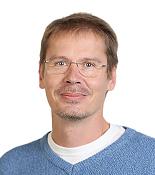
Team Leader
EMBL Imaging Centre
ORCID: 0000-0001-7098-0700
EditThe team is working on a range of advanced imaging methods in the field of light microscopy (super-resolution microscopy, lightsheet imaging) and correlative light and electron microscopy (cryo-fluorescence). A strong focus of the team lies on methods that can be incorporated into service workflows in the EMBL Imaging Centre. Potential future development interests also lie in the area of multiplexed/high throughput imaging using advanced lightsheet methods and the associated data management and processing.
The groups listed here are working on development of technologies in automation, robotics and/or microfluidics.
Snr Team Leader – Prot Sequence Resource
EditThe sequence families team develops the InterPro, Pfam, Rfam and RNAcentral databases. This provides and excellent environment to learn and help develop cutting edge information resources. At present we are rapidly adopting AI technologies to assist in coding and curation. There are many opportunities and we are increasing our ambitions to provide detailed and accurate biological information more rapidly to the community. Projects could focus on using AI to improve data, or the software infrastructure for any of the data resources we provide.
Team Leader
EditOur team develops and applies Biological Small-Angle X-ray Scattering (BioSAXS) methods to support structural biology research, combining experimental development, beamline operation, and user service provision. We advance SAXS methodologies, including high-throughput and complex sample-environment approaches, while continuously improving beamline infrastructure, data workflows, and user-facing services. Current and future developments may involve both computational and experimental directions, such as data-processing pipelines, databases, automation strategies, or innovative sample environments. Fellows will have the opportunity to contribute according to their expertise, whether in computational method development, experimental instrumentation, sample-environment innovation, or integrated service provision within a collaborative and multidisciplinary beamline environment.

LAR Manager
EditOur team focuses on developing and optimising operational pipelines for high‑quality biological sample generation, with a particular emphasis on early‑stage tissue handling, standardised processing workflows, and scalable cohort logistics. These pipelines form the foundation for downstream multi‑omics, imaging, and AI‑driven analyses, and are essential for ensuring reproducibility and FAIR data integration across projects. We are currently expanding our capabilities to support the Lifecourse programme, where efficient and standardised sample processing has been identified as a major bottleneck for future scaling. The group provides an ideal environment for fellows to learn workflow engineering, automation‑ready sample handling, quality control, and service‑oriented project management, while contributing to the development of robust technologies that support external users.
Head of Light Imaging Facility
EditThe EMBL Rome Light Imaging Facility is seeking ARISE2 postdoctoral fellows to develop automated imaging technology and image analysis for large-scale biological research. We develop technology that transforms service provision in imaging-based spatial omics as well as general areas of fluorescence microscopy and image analysis. Possible projects include “lab-in-the-loop” approaches for smart microscopy, robotics, and automation, as well as software development pipelines for image analysis.
Protein Function Content Team Leader
EditOur group is developing scalable technologies to modernise expert biocuration, moving from predominantly manual workflows towards AI-assisted curation while maintaining UniProt’s high standards of quality, reliability, and scientific accuracy. Current and future work focuses on developing human-in-the-loop AI models and curation tools that can extract, structure, and validate biological knowledge from the literature and other data sources at scale. An ARISE2 fellow would contribute to the development of specialised AI models for vaccine capsular antigen curation, enabling relevant antigen information to be captured, standardised, and delivered through UniProt for use by the wider research community. This technology will support FAIR data management by converting unstructured biological knowledge into structured, traceable, interoperable, and reusable annotations, with community feedback used to refine the models and improve service provision for external researchers.
Head of Crystallisation Facility
EditThe Marquez Team has pioneered the development of Online Crystallography; fully automated protein-to-structure pipelines integrating crystallization, synchrotron data collection, and crystallographic data analysis into continuous workflows operated via the web. These pipelines rely on the CrystalDirect technology and the Crystallography Data Management system and have been fully integrated with automated data collection at the ESRF synchrotron, enabling rapid structure determination and large-scale X-ray-based fragment screening. Our facility generates large amounts of AI-ready data, and we are now extending our work to introduce Machine Learning (ML) approaches for AI-driven automation and for hit-to-lead optimisation and structure-based drug design. Our interdisciplinary team offers opportunities for scientists, engineers, and software developers to work in one of the leading infrastructures for structural biology within the areas of protein crystallography, fragment screening, drug design, automation, and large-scale scientific data management and Machine Learning. Currently, we are particularly interested in profiles in structural biology or computer science oriented towards one or several of the following areas: fragment screening, structure-guided drug design, machine learning, and artificial intelligence.
Team Leader
EditThe Papp Team at EMBL Grenoble develops scientific instrumentation for macromolecular X-ray Crystallography and Cryo-Electron Microscopy applications. One of our most recent and significant development projects is the EasyGrid technology, a system designed to fully automate sample preparation and quality control for cryo-imaging experiments. Pilot measurements demonstrated that the EasyGrid system is suitable for preparing samples for Single Particle Analysis experiments and showed the superiority of EasyGrid-prepared samples in terms of ice quality for Cryo-Electron Tomography and X-ray Nano Imaging techniques, compared to traditional plunge freezing equipment. Based on these solid technical developments, the team is now working on creating software tools to fully automate the Cryo-EM/ET sample preparation workflow, including an AI-based system for preparation parameter optimization using an on-the-fly sample quality control method.
Head of Scientific Instrumentation Workshops
EditThe instrumentation development team in the Scientific Instrumentation Workshops develops custom hardware platforms that enable new experimental capabilities for researchers at EMBL. The team is tightly integrated with our mechanical and electronics workshops, allowing quick prototyping and development cycles for even complex instrumentation projects. We have strong expertise in integrated electro-mechanical technologies that enhance sample handling and measurement workflows, and our current focus areas include: high-throughput (micro)fluidic handling; integration of fluid measurement cells into light and x-ray microscopy; and sample handling for cryo-EM. We are available as a collaboration partner across all facets of life science research at EMBL.
The groups listed here are working on development of technologies in (bio)chemical engineering and genetic engineering
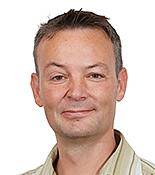
Head of Gene Editing & Virus Facility
EditThe Gene Editing and Virus Facility establishes ethical frameworks, designs strategies, develops reagents, optimises delivery, and ensures accurate detection of gene-edits. All these elements are areas of active innovation and evolution. For example, recently, we established high-frequency targeted DNA knock-in via viral delivery into mouse embryos, which was further developed using an all-in-one AAV containing an evolved novel mini-Cas9, gRNA, and repair template. Future work is to take this in-house expertise and expand the functionality of these tools across a more diverse range of organisms within the Kingdom Animalia.
Group Leader
EditOur group is developing enabling technologies that push the technical limits in spatial biology research and applying them for understanding how molecular and spatial composition of cells relates to their phenotype. We have set up cutting-edge methods that integrate advanced imaging and omics (SABER, Light-Seq) down to subcellular spatial omics, and implement automated workflows for hardware-software communication for adaptive feedback microscopy. We are particularly interested in spatial organization of subcellular compartments and their transcriptomic and proteomic composition. We have recently developed a new in situ proximity detection approach (ProPER) and would like to develop new applications for high-throughput in situ annotation of molecular states of RNA and proteins, high-fidelity detection of small and/or surface RNAs, as well as cell-cell interactions. We would also incorporate this approach together with other commercial and custom spatial omics methods.
A number of partner organisations are participating in the ARISE2 programme.
Some are open to full collaborations where they support fellows during the 3-year research projects offering additional expertise and technologies that may not be available at EMBL.





Many partners offer secondment opportunities (2-6 months long secondments or 1-2 week short visits) where they collaborate with fellows on a part of the research project or provide job shadowing opportunities. If the partner is collaborating on the full 3-year research project, fellows may spend up to 11 months on secondment with them.

ARINAX





Luxendo Bruker


VBCF
Weizmann Institute of Science

VBCF
The programme also has an implementing partner, RIcapacity, who is involved in the development of partnerships and the training programme in professional management skills for research infrastructure scientists. Associated partner, BII, will also contribute specifically to the training programme. Based on topics/themes, the following associated partners will also contribute their expertise to the training programme: ARINAX, CEITEC, Cellzome/GSK, CRG, ESRF, Leica, Luxendo Bruker, SciLifeLab, UGA, VIB

RIcapacity
BII
Event Overview
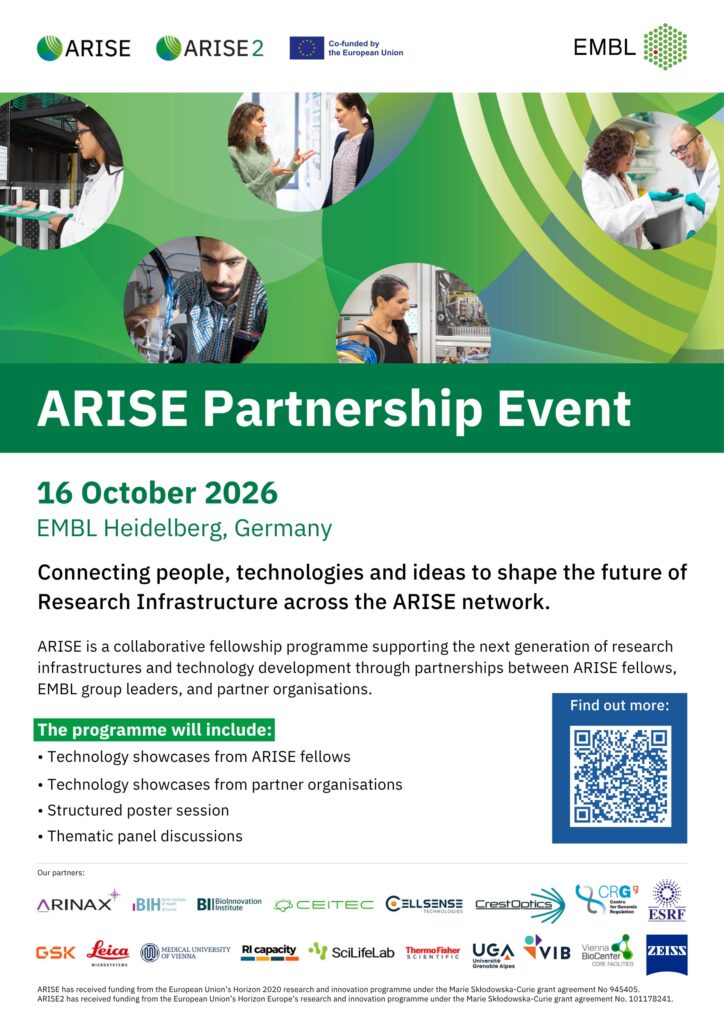
The ARISE2 Symposium and Partnership Event on Technology Development in Life Science Research Infrastructures will take place on Friday 16th October 2026, at EMBL Heidelberg, Germany. The programme aims to connect people, technologies and ideas to share the future of research infrastructures across the ARISE network.
The symposium will bring together senior RI scientists, ARISE and ARISE2 fellows, and partners from across research infrastructures to showcase technology developments and services in the areas of:
The symposium will feature structured talks, poster sessions, and thematic panel discussions, offering participants the opportunity to exchange experiences, strengthen collaborations, and engage directly with partner institutions and fellows.
Postdoctoral Fellow (ARISE2)
Genome Analysis
Edit
Postdoctoral Fellow (ARISE2)
Microbial Automation and Culturomics Core Facility
Edit
Postdoctoral Fellow (ARISE2)
Light Imaging Facility
Edit
Research Fellow (ARISE)
Saka Group
Edit
Head of Light Imaging Facility
Light Imaging Facility
Edit
Team Leader
McCarthy Team
Edit
Research Fellow (ARISE)
Protein Data Bank in Europe
Edit
Postdoctoral Fellow (ARISE2)
Bateman Group
Edit
Postdoctoral Fellow (ARISE2)
Protein Data Bank in Europe
Edit
Research Fellow (ARISE)
Proteomics Core Facility
Edit
Postdoctoral Fellow (ARISE2)
Sharpe Group
Edit
Postdoctoral Fellow (ARISE2)
Bernabeu Group
Edit
Technology Director
VIB
Head of BioInformatics Unit
Weizmann Institute of Science
Head of Screening Core
VIB

Visitor
Open Targets
EditVienna BioCenter Core Facilities | GSK | VIB |
| SciLifeLab | CEITEC | ARINAX |
| ESRF | ThermoFisher | University Grenoble Alpes |
Registration:
https://easy-feedback.de/s/2111391/5QwFP1g
Accommodation
Accommodation is not included. As a guide, here is a list of hotels you may want to consider should you require overnight accommodation:
ISG Hotel – nearest hotel to the EMBL Campus
Staycity Aparthotel Heidelberg
Onsite information:
Address: EMBL, Meyerhofstraße 1, 69117 Heidelberg, Germany. For further information on getting to EMBL Heidelberg visit Public Transportation to the Venue.
Nermin Akduman, EMBL
Hans Blom, SciLifeLab
Alvaro Crevenna, EMBL
Andrew McCarthy, EMBL
Montserrat Soler, ESRF
Marc Storms, Thermo Fisher
Disha Tandon, EMBL
Joanna Timmins, UGA
Contacts
arise@embl.de
arise2@embl.org
tanja.ninkovic@ricapacity.com

Duration of fellowship: 3 years
Number of fellowships: 17
Dates: 2026 Call
Call opening: 30.06.2026
Call closing: 30.09.2026
Interviews:November 25-27, 2026
Fellowship Start: 01.01.2027 (or within next 4 months)
Contact: arise2@embl.org